
Practical guide · Trading consistency
Trading tilt: how to recognise patterns across a session
Start with what changed in your execution: entry timing, stop management, trade frequency and adherence to your limits. Review those actions in time order against your written plan. One loss or one warning is not a diagnosis; a repeated departure from your rules is a concrete reason to review your decisions.
1. What is tilt in trading?
Traders use “tilt” to describe decisions drifting away from their intended process, often around frustrating or exciting results. In this guide, recognition means identifying observable behaviour—not detecting an emotional state. The same action can have different explanations, and a valid strategy may involve fast entries or planned stop adjustments.
Revenge trading is one loss-related pattern, not the whole subject. A session review also examines repeated timing departures, changing risk and rule breaches, including on profitable days. Research on trading frequency and risk-taking provides context, but is not a test that diagnoses an individual trader.
2. Four observable markers to review
The review questions below are general guidance. The Valiento notes describe specific product signals, not universal definitions of tilt.
Entry timing
Compare entries with the setup and timing written in your plan. Look for repeated departures, not just a fast trade.
In Valiento: Valiento flags multiple recorded mid-candle entries in a session. A mid-candle entry is not automatically wrong for every strategy.
Stop management
Review the direction, number and timing of stop changes on the same trade. Distinguish planned adjustments from widening risk.
In Valiento: Recorded triggers include a third stop widening and three or more stop moves within five minutes. Stop-management warnings without recorded losses can be labelled hesitation rather than tilt.
Trade frequency
Compare the sequence with your own trade-count limit and planned pace. Fast execution alone does not establish a problem.
In Valiento: Valiento checks recorded trade count against your limits and can flag rapid re-entry after a recorded loss. That loss-led pattern is covered in the revenge-trading article.
Risk and plan drift
Check actual risk against your written rules, even when a trade finishes profitable.
In Valiento: Valiento records plan and limit warnings based on available trade facts and the limits you set. A winning result does not erase a recorded breach.
3. Read the sequence, not just the result
For each recorded warning, find the triggering action, its timestamp, the applicable rule and the next recorded action. Ask whether the same behaviour repeated or whether execution returned to the plan. Check missing entries and exits before drawing conclusions.
Hypothetical review example—not a real session
A trader plans to enter only after candle close. Two mid-candle entries are then recorded, followed by repeated stop changes on a later trade. The final trade makes a profit. The useful conclusion is that timing departures and stop changes occurred—not that the trader felt fear, and not that profit made the execution disciplined.
Keep different signals separate. An entry warning, a stop-management warning and a loss-limit breach are different facts. Do not turn a cluster into a stronger label than the evidence supports.
4. What Valiento’s timeline levels mean
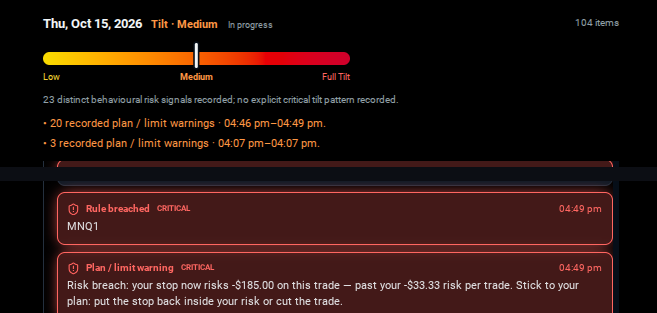
- Low: no countable behavioural-risk signals were recorded. It does not prove every trade was captured or every rule was followed.
- Medium: countable behavioural-risk evidence, including rule breaches or non-informational plan warnings, was recorded without an explicit critical tilt-pattern event.
- Full Tilt: an explicit critical tilt-pattern event was recorded. Several red warnings alone do not automatically establish this label.
The label reflects the highest recorded evidence for the session, not mood at the end or a grade for P&L. It is provisional until the configured market close. Timestamps use the display timezone; grouping follows market-session boundaries. Linked messages can remain visible without counting the same event twice, and informational plan reminders are not breaches. The display summary does not change engine scores.
5. A practical consistency review
- Confirm the session, timezone and completed-trade records. Leave unresolved gaps visible.
- Compare the first departure from your plan with the actions that followed it.
- Review profitable trades as well as losses. Separate execution quality from financial outcome.
- Record what went well too: respected risk, planned entries and completed trades without recorded breaches.
- Choose one observable point to review next session, such as entry timing or stop changes. Compare similar sessions over time rather than treating one day as proof of improvement.
If a warning appears while trading, check its facts against your plan and limits before another decision. This is a review routine, not a recommendation to buy, sell or manage a particular position.
6. What Valiento can—and cannot—record
Valiento flags behavioural drift from your plan using activity recorded by its connected browser extension on TradingView. You must place and manage trades there with the extension connected. It does not directly connect to NinjaTrader, Tradovate outside TradingView or prop-firm websites. Linking an account alone is not proof of coverage.
Warnings are advisory: Valiento does not block orders, diagnose emotions, guarantee consistency or promise challenge success. Missing data limits the review. For prop-firm accounts, your provider’s rules and dashboard remain authoritative.
Explore ValientoResearch context and related reading
These studies concern group-level trading behaviour, not Valiento’s accuracy or an individual tilt diagnosis.